For those unable to see this film
How I read and understand
Asoka Handagama’s new film “ Let Her Cry”
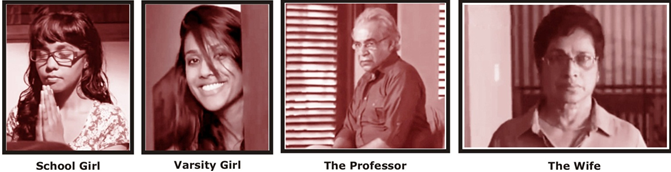
The main story of the film is woven round the life of an aging University Professor, his wife and school going teenage daughter and we are told later, that there is also a son of marriageable age in USA.
What is important to observe is the portrayal of the characters and the situations lined up, which helps the viewer to correctly understand the human drama, behind these lives. What is revealed through the picture frames are only small fragments, like separated pieces in a jig saw puzzle and the viewer has to exercise his intelligence to piece-to-gether appropriately the fragments, to see the picture in its totality. This could be done, only after the end of the film, by sober reflection.
The fact of humdrum, routinized, staid lives of the three characters are amply depicted and driven home effectively to the viewer. The Professor returns home from work, and knocks on the front door, the daughter perched on a couch curled up, always watching television, gets up to unlatch the door to let the father in, and these are no words of welcome spoken except a monosyllable “Hi” , she gets back to the couch and to her posture to continue watching television.
In silence, the Professor drops the slab of chocolate he brings daily, on to the daughter’s lap and mechanically she unwraps it and proceeds to eat.
The Professor ascends the adjacent stairs, and on his way up, sees the wife in the shrine room, standing with clasped hands, worshipping. Their eyes meet, but no words are spoken. In his bedroom now, seated on the bed, Professor begins to undress. Halfway, the wife arrives to hand over the towel, pick the worn shirt, and collect the shoes to be placed on the shoe-rack. Professor retires to the bathroom. The repetition of this scenario, drives home to the viewer, the invariable daily routine in this house.
In this house, there is no laughter, there are no tears, no expressions of emotions, no endearing exchanges of words, no bubbling of life, But, solemn serenity pervades, everything is prim and proper, and life flows on, uneventfully.
The next character to enter is the varsity girl, not a lass in typical blue jeans and T-shirt, not a post-pubescent specimen of youthful exhuberance. Dressed in silky voiles she is thin, emaciated, seems to have a dreamy look, yet with a streak of youthful sensuousness. It appeared she is striving to build up a relationship with the aging Professor. This infatuated behavior goes un-,responded for quite sometime by the Professor, who is mentally and physically in a semi flaccid state. His negative gestures intensifies the heat of the girls’ infatuation and she becomes bolder, more persistent and forcefully barges into his life. The Professor is goaded into resuscitating and re-kindling his long dead sexual drive and the varsity girl graduates her relationship from the mental plane to the physical. Secret exchanges, secret meetings, and secret embraces, begin.
Professor’s wife smells a rat. No tantrums but only a few sober cross-checking through questions about movements, locations and behaviors. Varsity girl’s behavior becomes more bizzare. She telephones the wife relates of, one to one meetings with the Professor and even of the intention of having a child by him Perhaps a streak of sadism emerged in the varsity girl’s mind to give the wife, the rival in her love, a painful shock to know, that her beloved possession, her private property is now being commanded, shared and will be ultimately acquired by the latter. The possibility of dispossession, physical and emotional, raises alarms in the wife’s mind. But surprising the viewer, she remains calm, yet alert.
The ostensible reason for the wife’s extra-ordinary move to invite the varsity girl to reside in their house is to thwart any public gossip that can arise that the Professor is having an affair with the girl will be bad for his reputation.It would appear to be a dangerous act by The Wife like bringing hay close to a fire.
There is no clue whether this extra-ordinary invitation is born out of a profound understanding of human psychology or some unexplainable feminine intuition arising from her own mature thinking. Or did she anticipate that the novelty of this new relationship will wear off eventually, the raging fire will subside, dissipate and finally be extinguished, saving the public reputation of everyone concerned. Heaven will only know.
Yet, the presence of the youthful varsity girl creates a magical transformation in the Professor’s home. There is a new eagerness to talk, to know, to discuss, to inter-act. There is exchange of information, the sharing of views.
In this manner we are told that the varsity girl had been a fatherless child that survived in a love-less world, that she is intelligent and bright in her studies, that she could cook meals very well and so on.
The hitherto lonesome introverted school girl finds in the varsity girl a pleasant companion. And they get on famously, sharing their laughter, their secrets and their little jokes breaking into uncontrollable laughter while travelling together to school. Ofcourse, once the school girl disembarks from the car, something else happens and the lovelorn varsity girl climbs in to the front seat to flirt with the Professor.
There is no gainsaying that the varsity girl brought liveliness into the house of the Professor, which was previously dull and dismal. The change was obviously felt by all, as The Wife remarked later, when the varsity girl had departed, “ There is some emptiness in this House” This is a profound human observation that Handagama has articulated through the lips of The Wife.
The varsity girl’s presence in the house does not create any tension for The Wife and the girl is seen moving about freely. There is no locking of doors, or waking up in the night to see whether the husband is in bed or somewhere else or any such “ safety measures” being taken by The Wife.
The Wife appears relaxed, a master of her own emotions, taming her ego to the maximum possible level. Hatred could be neutralized, she may have thought, by the opposing force of compassion. This is the stuff, as Buddha has said, that goes to make arahants. The masterful control of her emotions, even in the face of grave provocation is depicted to an unbelievable level.
There are several noteworthy episodes portrayed during the stay of the varsity girl.
On bed, The Wife strokes the Professor’s body in an attempt to kindle some spark of sexual response but fails and she gives up. It appeared the Professor was sexually, dead as the dodo. However, it is shown that the old boy has dreamy fantasies of sex with the varsity girl embracing her semi-nude nubile body. On one such dreamy day, The Wife noticed that the sleeping Professor had registered a hundred percent penile erection. The amazed wife gazed on at this miraculous spectacle achieved through dreams, whereas she had failed with her own hands! The autonomous nervous system had activated, what had been dead for years. The need to protect the Professor intensified in her mind.
On a day professor visits the varsity girl’s boarding house, she brings a basket of vegetables and proceeds in a delightful mood, to make a tasty meal for her father figure.
Completing the cooking the varsity girl looked for the Professor everywhere, but he had slipped out. She completely loses her balance, hell breaks loose, and in an uncontrollable fit of rage she smashes up the entire kitchen pots and pans, fried rice and chicken curry flying in different directions. This is a projection of her inability to contain disappointment.
The portrayal of the personality of the teenage school girl is designed to suit Handagama’s interpretation of the character. She is bespectacled, result of being glued to the television all day, she is dressed at home in one-half pants and loose blouse, the fashionable in-thing of youth.She is sedate, inexpressive , non-communicative. These are all symptomatic of stunted emotional development. A cloistered over-protected and isolated child necessarily will acquire and inherit a stunted personality, is what Handagama points out.
But how she opens out her heart and thereby her emotions is clearly seen when she is exposed to the company and friendship of the varsity girl, both comparatively young. Her complete transformation is portrayed by the behavior in the rear seat of the car while in transit to school, letting loose all inhibitions, uncontrollable laughter tickling their ribs, camaraderie being consolidated.
But, there are two notable “relapses” in behavior that occur in the case of the school girl.
While traveling to school, on some argument arisen, the professor pushes back his daughter. The school girl alights from the car, and runs away, at speed. The varsity girl highly disturbed runs behind in hot pursuit. Their path lead to a rail track and there is an on-coming train. In the nick of time, the school girl is pushed away from the rail track, by the varsity girl and her life is saved.
Emotionally charged adolescents who cannot cope with their tensions are prone to suicide.
A second crisis of the school girl is at home. Perched on her couch her resentment against not being taken to the Temple is blurted out by controlled screams, grunts and guttural sounds and violent, trance like shaking of the head repetitiously for some time. This is her expression of dissent, and resentment, non- verbal, animal like and bizzare, The professor gets behind her, places his hands on the girl’s head, and protectively, and fatherly ,strokes her head gently and the girl calms down.
The inability of the school girl to use humanity’s most important break-through in civilization, of verbal communication to express thoughts ,views, ideas and emotions and dissent through language, she had not cultivated. Her resentment is manifested by animal noises. Language inadequacy cripples the mind and the personality.
These are two cameos depicting adolescent behavior which Handagama has captured in his camera.
Another important episode is, when alone in the house, the professor dressed in, only a towel, ventures in to the drawing room, and turns on the music, starts dancing and prancing, then mimic his daughter with head phones on, perched on the couch, and finally ends up in the bedroom of the varsity girl to daydream a multi-colour, lurid sexual fantasy.
This is a strong depiction of the duality of the human psyche. Well-dressed in the clothes of civilization and morality, there dwells the inhibited man, while what Handagama shows on the screen, is the same man, in his uninhibited state. It was Freud who took up the position that culture produces pathogenic conditions.
A crisis brews when The Wife finds out that “ the couple” had met in secret out side and on cross examination, the varsity girl comes out with the lurid details of their meeting. The varsity girl, dressed in a towel at the time unwraps and reveals her naked body to The Wife. The long subdued and suppressed anger of the Wife, breaks out in a rush and in vituperation, blurts out the ultimate insult one woman can hurl at another, “Patta Vesi”. A great moment of weekness, of an otherwise great apostle of equanimity.
This crisis results in the varsity girl, packing her bag and leaving.
The storm has passed over, calm and balance was restored in the household. There was calm and peace but, as The Wife remarked to the other two, “There is some emptiness!” The varsity girl had taken away the effervescent liveliness that had been infused through her presence.
The brazen intrusion of the varsity girl threatening the long held marriage bond of the married couple was a severe, damaging strain on the mental make up of both. The process of resolving their distress takes place in the locus of the bedroom, the arena of their now historical marital ecstasies. There are exchanges of harsh words, recriminations and a controlled fight on the bed, tears flowing, like two aged antelopes with locked horns, pushing each other with hands, wrenching and squeezing. The “fight” subsides, one body on top of the other and the bed sheet is raised over to cover both, and this heaving mountain of flesh is fully covered thereafter with the bed sheet and every thing finally becomes still.
They had interacted, then reconciled to reality, and resolved their crisis, covered their private shame and the world will not know their secrets. They had reached the winter of their discontent.
The final episode in this film, deftly executed by Handagama which according to my view is the main event and the justification for crafting this story, and this film. It has a stunning effect on the viewer, which was the obvious intention of Handagama.
In the serene atmosphere of the Temple, as darkness descends slowly heralding the eventide, the family proceeds to worship the deities. Many others are seen, all dressed in white, moving about in measured steps, calm and disciplined. The varsity girl is also seen, appropriately dressed in virginal white, offering flowers to the Buddha. A typical devout atmosphere prevails.
A Montero Jeep arrives, right up to the worshipping area. A politician, his wife, and child alight and a bunch of his supporters also appears on the scene.
The politician’s wife a robust well-fed woman in surgical white modern dress, holding a tray of flowers slowly proceeds with the child towards the shrine. Suddenly, the woman stops dead in her tracks, focusing at a girl seated on the sand at a distance, her hands clasped and head bowed in obeisance. This girl is dressed in jeans and white blouse.
The woman lets out a blood curdling scream and darts across, straight at the girl. The worshipping girl is attacked mercilessly and brutally by the woman while screaming abuse at the same time. The abusve words indicated that this girl is a sexual object of the politician. Supporters of the politician and other devotees join in the fray and a tumultuous free for all riot takes
place, right at the centre of worship. Flames of anger and violence consuming the entire crowd generate a scorching heat. A pistol is fired in the air by the security personnel. The political woman grabs a steel candelabra lifts it as a weapon and runs after the fleeing girl who finally runs to safety, outside the temple.
Unexpectedly, rain, soothing rain, descends on the over-heated crowd in the temple. Thick rain drenches the crowd and the flames of anger and violence are doused. The crowd finally disperse ,while a drizzle continues.
The violent drama in the holy precincts appear totally unconnected to the main story, it appears at first sight and one could ask, “ what is the connection”.
The final incident presented in a pithy but stunning way is juxtaposed with the long drawn main incident, both springing from an identical cause, marital infidelity. Handagama juxtaposes the cultured measured response of The Wife to her private distress and the sound and fury of the politician’s wife to her own distress and poses the question to us, ’’ which do you prefer to follow, in similar circumstances. Equanimity or Brutality; cultured, noble conduct of the Aryan or the brutal violence of the barbarian? Which would you follow? Dear spectator?
Handagama does not teach us any lessons. He only portrays the events/behaviors through the medium of actors and picture frames. We have to, look and learn, our own lessons from them, each according to his ability, attitude and knowledge. “Pachchath-thang Vedi-Thabbo” See through the reality, by your own efforts.
To me, the entire film was like a workshop on human behavior, where a whole series of anecdotes and behaviors are mirror imaged by Handagama, and laid bare for our critical examination and to arrive at appropropriate inferences Moral Codes are really human cultural constructs, subject to change like other phenomena. There is nothing that is permanent and everlasting.
In Agganna Sutra, verse No. 16, 17 the Buddha stated “ That which was reckoned to be immoral- adhamma – at the time, is now reckoned to be moral – Dhamma – “ The Buddha was in fact commenting on the monogamous pairing off of couples at the inception which was the precursor to modern marriage, considered immoral – Asuchi –unclean -. Today, it is considered moral. And tomorrow, this might change.
At the stormy end of Handagama’s film, we hear the lion’s roar of Chitral Somapala’s voice imploring us,
මුළු වැස්සම ගිණිගත්ත
ඒ නිලංකාර සිහිනෙන්, ඇහැරෙන්න!
Wakeup from your blue dreams.
Open your eyes and see reality!
TAIL PIECE:
The character of the varsity girl is central to the story and her behavior and relationship with the Professor poses to the viewer, a conundrum difficult to untangle. The little scraps of information provided by Handagama about her past, are, rural background, never had a father, of low-income, diligent in studies, monk in village Temple scolds her. Her current behavior could be broadly classified as being insensitive to feelings of others, or public opinion, stubborn to have her own way, non dependent on others, determined to pursue her own dream.
From all these available raw material, through a process of imagined regression, a re-construction tracing her emotional development is possible, to throw some light on her present perplexing views and behaviors.
The following is my re-construction.
A fatherless child, most probably illegitimate, ostracized, neglected, marginalized and looked down upon, but with genetically inherited intelligence, self propelling her lonely journey through childhood and adolescence survives in a harsh environment, like a rose in an arid desert, stunted, but nevertheless a rose. She is insensitive to every thing and every one, her singular objective being, survival.She becomes a winner, defeating others, nationally, to enter the campus, which has infused her with the delusion that, she had reached the pinnacle of her life through her “own Way”.
In her distorted perception of her future life, her family will be “ Me and my child”. The image of “Father” has been totally erased from her mind. In her life, she will have to love, which will lead to sex, and sex will lead to a child. But, her fantasy family will have no father, that is she will not have a husband. So to accomplish her dream of begetting a child, to start a mother-child family, she will have to steal someone else’s husband. The easy target at hand, is the father figure, the harmless grey haired Professor, the surrogate father. She is brutally ruthless about the social consequences to herself and to others and displays unbelievable conduct in pursuing her dream. This is the train of thoughts that propels her forward.
She is not a “ “ Sex-charged bitch” as some may perceive , but only a young woman on the threshold of adult life, who had developed a warped mind through a harsh and cruel environment which denied her a balanced emotional growth.
It would not be out of place to mention here that, in cases of this nature, one week of cognitive behavioral therapy by a competent psychiatrist can re-adjust her mental health and she could lead a normal, conventional and productive life.
To watch the theme song of the film Click here
Analysis by
Upul Ranjit Fernando
– Upul Ranjit Fernando –

Leave a Reply