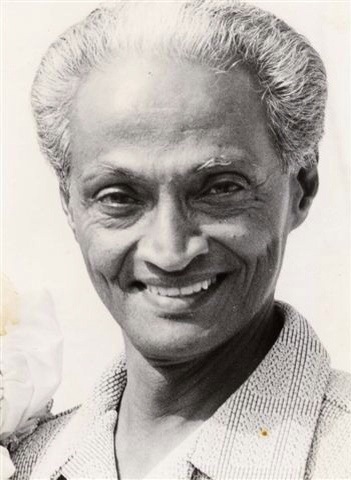


A deeply human and noble Sri Lankan, Bala Tampoe, who laboured a life-time for our workers, departed from life
Bala Tampoe was born in 1922, to an aristocratic Jaffna Tamil family. He was educated at Royal College and entered Peradeniya University and completed his degree in Botany. He also obtained a degree from the London University. He served as a Lecturer in the Peradeniya Agricultural School and was dismissed from government service in 1947,for participating in the 1947,
- C. S. U., government servants’ strike, led by T. B. Illangaratne.
He was married to a Montessori teacher, Nancy Kotelawala and had a son and a daughter. His wife died and the two children emigrated.
In 1953 he qualified as a Lawyer, specialising in criminal law.
Prior to that, in 1948, the Ceylon Mercantile Union led by A. E. Gunasinghe had a vacancy for the post of General Secretary. Bala Tampoe was selected for the post.
Bala had been an activist, from his university days and identified himself with anti-imperialist forces, and the marxist movement in the country. He joined the LSSP and became a leader.
In 1963, when the LSSP decided to join the SLFP in collation politics, Bala and a few others became the dissident group and broke away from the LSSP and formed the LSSP (R) – Revolutionary. Edmund Samarakkody, Merril Fernando, Sydney Wanasinghe, V. Karalasingham and Bala formed the LSSP(R)
In 1966, Bala Tampoe married May Wickramasuriya who worked as a Secretary in the C. M. U. office. May, who was a dedicated leftist activist, was sister to Desmond Wickramasuriya and Colonel Lyn Wickramasuriya and was from a highly respectable family in Matara. Desmond Wickramasuriya who was connected to the LSSP as a brilliant journalist and marxist theoretician, assisted the Ceylon Bank Employees’ Union for 20 years.
Bala Tampoe appeared for the accused persons of the JVP insurrection and during the trial of Wijeweera, was requested to apologies to Court for some provocative remark Bala had made about the Court, by the Chief Justice, H. N. G. Fernando who was hearing the case. But, Bala refused and was told “In that case, do not come to this Court hereafter”. Bala never went, and his junior H. A. Seneviratne handled the case thereafter.
The Ceylon Mercantile Union – CMU
The Union had been formed by A. E. Gunasinghe known as the Father of Trade Unionism in Sri Lanka. Gunasinghe received a ministerial post under the D. S. Senanayake government and left the CMU. Bala filled the vacancy and continued the role for over 60 years.
He was well equipped to play the role of a Trade Union Leader with his university education, marxist orientation and legal training. Problem solving was an easy vocation for a man with such a rich background, and his continued success at negotiations, arbitrations, collective agreements, and at Labour Tribunal, Industrial Courts made him the doyen of trade unionists in Sri Lanka.
He took a principled public stand against the Emergency Rule, the use of the harsh Public Security Act, and the ruthless Essential Services Orders against striking employees and organized the CMU members to publicly demonstrate the opposition to these repressive legislation in joint-action with other trade unions. Later, he condemned the Executive Presidency which threatened democratic governance of the country and his public statement on the eve of the 2010 Presidential Election spelt out his thinking, on the election and its outcome.
“The severe hardships suffered by the entire population because of the phenomenal rise in inflation and the cost of living caused by the war have not yet been reduced. The huge “Security” expenditure involved, amounting to hundreds of billions of Rupees, continues with the continuing “State of Emergency, and financial corruption in that regard, too, no doubt. Furthermore, the huge debts incurred by the Government will remain as a burden on the masses of the working people. The huge loan 2.6 billion US dollars (approximately 286 billion Rupees) that the Government found it necessary to request from the International Monetary Fund (IMF), and the conditions for its grant will have to be met. The IMF Chairman has explained that the loan was granted to prevent the collapse of our country’s economy.
Having regard to all the above–mentioned facts and circumstances, our Executive Committee considers that the re-election of President Rajapaksa will only mean the continuance of the working people, under the continuing political conditions of an already militarised society, in which democratic and human rights are no longer respected by the ruling regime. We have no reason to believe that General Fonseka will end this situation, and change it for the better, for the working people, with the political support of the UNP and the JVP.
It is our considered view, therefore, that our Union and other organizations of the working people, in urban as well as rural areas, will have to rely on their own strength and their capacity to combine their forces to deal with the situation that they will have to face after 26th January, whether President Mahinda Rajapaksa is re-elected, or is displaced by General Sarath Fonseka”.
This was the classical and principled stand on which Bala stood for years and years, never supporting parliamentary political parties, and he exhorted the working class to rely on its own organized strength to defend its rights.
Struggles of the CMU
The Ceylon Mercantile Union consisted of employees in numerous organisations functioning in different sectors of the economy. It had a majority of white-collar office workers but also had a large component of blue-collared workers coming under different laws of the country. Shop and Office Employees’ Act, Wages Ordinance, Factory Ordinance, Voluntary and Compulsory Arbitration Procedures, Employees Termination Act, Labour Tribunals and Industrial Courts are some of the premises and pieces of legislation on which he sought relief and redress for the multi-faceted grievances of his diverse membership.
Some of the historic struggles of the CMU were as follows :- Plate Photographic Co. Times of Ceylon Lockout (1957), Lake House Strike (1959), Brooke Bonds Bonus Strike (1963) Port Strike (1964), Browns Bonus Strike, Whittal Bousteads Strike (1965) SLRC Strike (1966) AMW Kalutara Strike (1969), Lucky Industries Garments Strike, Fertizer Corporation Strike (1975), Paranthan Chemicals, Poly Tex Strike (1994), Coca-Cola Strike (1996).
All these struggles were for a fair wage and just terms and conditions of service. They were full of sweat, tears and even blood. The CMU was a beacon to the less fortunate workers and Bala fought against conditions of virtual slavery in which less – educated workers were held by both local and foreign employers of the various mercantile firms in operation. His militant leadership has left a rich legacy of not only militancy in trade unionism but ensured the security of employment and favourable terms and conditions for all, setting national standards for other workers to achieve.
A steady stream of numerous categories of workers from different parts of the country kept on visiting the CMU Headquarters, where Bala’s Mortal remains Lay-in-state, to pay their last respects to a leader who had given them, above all, dignity and honour in their working life, by taking their side, upholding their rights always, as against their employers.
Relations with the Ceylon Bank Employees’ Union
There were great similarities between the CMU and the CBEU. Both were fathered by A. E. Gunasinghe. Both were free of parliamentary party politics, independently functioning and had internal electoral processes by which leaders were elected and collective action was decided by the membership, by vote.
Bala was the mentor and advisor to the CBEU on many occasions especially when the CBEU had an independent – oriented leadership. From 1970s to 1990s he was close to the CBEU. Many Trade Union Fronts were formed mainly with ‘independent’ trade unions, such as Ceylon Estate Staffs’ Union, Post and Telecom Officers’ Union, Port Workers Union, Government Medical Officers’ Association (GMOA) and Free Trade Zone Union of Anton Marcus.
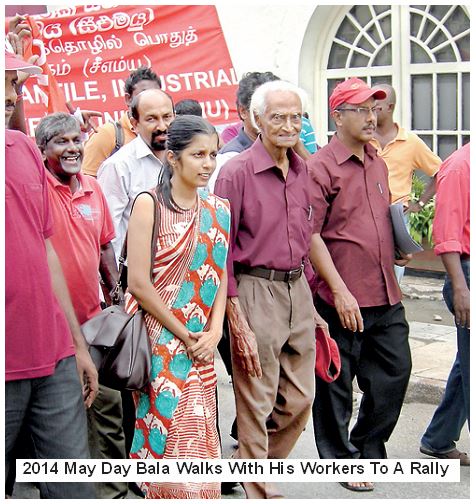
Joint May day rallies were consistently held from 1970s to end of 1990s with CMU, CBEU and the other unions mentioned above, which were the biggest worker gatherings sans party politics. Brave and bold Joint Statements were made, focusing on the issues confronting the working class at the times. Bala displayed his fiery oratory in bilingual glory, in a clear, enunciated, emphatic voice. All this now belongs to the glorious past, where the dissident Left, demonstrated its militancy as against the tamed Left of coalition politics.
Bala’s “Living” legacy to the workers
A true and tangible monetary legacy that Comrade Bala left behind to the workers of Sri Lanka is the Variable Cost of Living Allowance, paid monthly, on the sliding Cost of Living Index, COL, at Rs. 2/- per every point rise.
This monetary demand was obtained by Bala at the Collective Agreement with the Employers’ Federation of Ceylon in 1969. A very far-sighted move, this quantum is now a sizeable amount, with the unfailing steady rise of the Index.
Bank Employees were luckier. Following the foot-steps of their mentor and friend Bala, the leadership of the CBEU also signed a Collective Agreement in 1989, demanding and fixing, the variable increase at Rs. 2.50 per point rise in the Index. It would surprise everyone to know that bank employees COL allowance with this variable increases has risen to over 100 per cent of their basic salaries! The government sector also demanded for this allowance. It was paid for a short period but was “frozen” due to lack of finances. However, the beneficiaries, even at present, of this legacy that Bala has left behind, runs to several lakhs of workers and serves as a cushion against the ever-rising cost of living.
Bala reaches his final years
With the passing of the years, the CMU too contracted and the previous feverish activities in the office subsided. The Trade Union movement in the country weakened due to coalition politics and the previous fervor and militancy dwindled.
Bala had built the CMU Headquarters, just by the sea, at Kollupitiya and it continues to be a popular venue for Trade Union Meetings.
CMU members wanted to buy a new motor car for Bala, but he declined the offer. He faithfully battled on, starting the day, at 5 am, driving his famous green coloured Volkswagon Beetle to office. In 2014 May Day, he walked with the workers who paraded to a Rally. He was preparing the next Collective Agreement with the EFC and in July, is reported to have walked out in protest with other Trade Unions from the National Labour Advisory Council Meeting for its failure to implement the approved Workers’ Charter.
He was taken ill, some months back and he wrote his Last Will. The important matter for him, was the instruction to the CMU, not to permit the State to sponsor or arrange his funeral and that the CMU should attend to the task. Thus, his last journey was on the comfortable shoulders of workers he represented, all the way from Colombo 3 to Colombo 8. A noble man, thus departed.
Out of Sri Lanka’s Trade Unionists, this was the most worthy of them all. Choosing the grueling path of honesty, integrity and moral uprightness, denying to himself a life of comfort and ease, he lived a Spartan life. With the march of history, images will fade, but we shall never forget, the worthy contribution he made, to uplift the lives of oppressed workers, suffering so much, to make others enjoy, the fruits of his self-less sacrifices.
Sleep Well, Comrade Bala !.
You have indeed, done your best!
Ranjit Fernando
Former General Secretary of CBEU
30th Sept. 2014

Leave a Reply