HUMAN SEXUALITY IS A PRODUCT OF CULTURE
A Buddhist Perspective
Sensational reports of raping of females, from babies to old women in wheel chairs and sexual violence against male children are published, daily in Newspapers together with loud reactions from the “public”, – actually, by persons inflamed by “righteous indignation.” Perceptions of the problem vary, inasmuch as the solutions they offer. From castration of rapists to, considering all males as potential rapists and to mount 24 hour vigils to protect females, have been suggested. However, the problem has much deeper complexities that involves the human mind and the conditions under which it functions.
The genesis of all acts including sexual violence, is deeply rooted in the mind, and desire is one root, and the other two are hatred and delusion. The three words, desire, hatred and delusion are an abbreviated verbal representation of the entire gammut of human feelings expressed in words, thoughts and deeds, having. limitless variations. Conflict arises when such feelings clash with the established moral laws of the social group. The moral laws themselves are a product of culture, laws that will have to be collectively observed to ensure peaceful advancement of the social group. Society expects desire to be appropriately controlled to ensure its objective of peace. Hence the punishment for violations.
One thing that disturbs the human mind is desire, The sexuality of the humans, also generates desire of a sexual nature. On the question of uncontrollable desire, there is an interesting episode recorded in buddhist scriptures. A bhikku who could not quell his sexual urges castrated himself, and lay bleeding on the ground. When The Buddha was informed of this, He made the cryptic comment,
“When one thing needed to be cut-off, that foolish fellow has cut-off another !”
Instead of cutting-off desire, which disrupts the concentration of the mind, cutting off the penis does not offer any solution. Castrating rapists, is no solution either. For the problem of rape.
Unravelling, who will be potential rapists appears to cause some confusion in the public mind. That is why the protestors say: even doctors rape, lawyers rape, Buddhist monks rape and so on . Their real question is, who will not rape? Some deeper reflection brings out the answer quite easily. Those who have conditioned their minds against rape (or any other crime) are unlikely to commit that crime. This conditioning of the mind, is a womb to tomb process of moral restraints, cultivated mindfully and with commitment that produces the non-injurious being, the morally rich person. The law that governs this, is the Law of Conditioned Co-genesis, paticca sammupada. which governs human perception, consciousness and action. It is a Universal Principle which operates and is unrelated to Buddhas.
In India and in other oriental cultures, there are thousands of women, who may be uneducated, poor and even sickly, who will never commit adultery. On that matter, their minds are totally conditioned and there is no possibility of a breach. So it is with other “Crimes”. There are amongst us, many who will never murder another, never kill animals, and will never steal. How does this happen ? This is the moral conditioning of the mind at work. To any intelligent and discerning persons, there is no magic miracle in this, at all.
The Buddha has given a concised explanation in the Agganna Sutra (meaning “of the beginnings”) of the birth of human sexuality.
In the long evolutionary process of the human being, there was a turning point which gave rise to a completely new phase to human life. People began to differentiate between ‘male’ and ‘female’ on the basis of ‘marks’ and the way people gazed at the human form changed. As a result, burning entered the body of men and women and they began to lust for each other. Thereafter, men and women set to work to make households for themselves to indulge in exclusive sexual practices – Methuna Dhamma. The Buddha speaks of the separate household as a determinate historical formation which came into existence under specific conditions, after the transition to food production. Social conflicts and violence began, according to the Buddha, after the setting up of separate households.
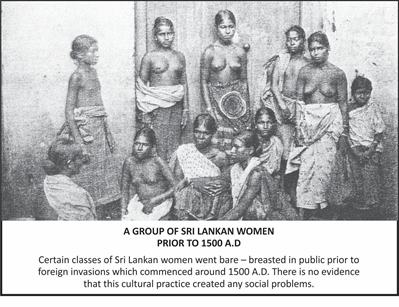

The perception of the female body as a sexual object is not due to any natural predetermination – it is a product of culture.
This is evidenced by the fact that in primitive societies of the hunter gathering stage, men, women, girls and boys were going about either nude or semi-nude, as is done even now in such existent societies. They do not seem to be sexually inflamed by the sight of each other and bare-breasted women are not charged with “indecent exposure”. In the eyes of the sexually inflamed person, the human form, especially the female human form, is a vessel of sensuality. This change of perception, produced a new discourse and a new morality.
The pairing off of a male and female and departure from the community for exclusive sexual activity, The Buddha points out, was at first, only for brief periods. Gradually, the period was extended, until the practice of pairing couples setting up separate households became normalized. At the beginning this setting up of separate households, was considered immoral. Later, it became to be considered moral. The Buddha made observation of this as, “That which was reckoned to be immoral – adhamma at the time, is now reckoned to be moral – dhamma” (Verses 16 – 17 – Agganna Sutra)
The perception of what is considered ‘normal’ and ‘abnormal’ practice has shifted and with it the affects and the moral sentiments of the people. Thus, it appears morality is not a fixed norm, when perceptions change, morality changes.
All sexual acts are impediments to reaching higher mental states and the Buddha decreed that bhikkus should be celibates, and listed over 200 sexual offences breach of which carried penalties. For ordinary persons, He recommended socially approved sexual conduct and promulgated the precept. “Kamesu Michcha – chara Veramani” refrain from sexual misconduct. In the Sapta Apirihani Dharma, He exhorted rulers to observe the law “to protect females from abduction and unlawful custody”, which He predicted would, with the other six rules, prevent the decline and fall of any society. It is stated in the Buddhist scriptures that the once resplendent Vajjian state, finally perished due to non adherence of the Sapta Apirihani Dharma. All these are steps The Buddha had taken to control harmful effects of sexual acts.
The Buddha’s doctrine helps one to understand the reality of the conditioning of the mind. All human beings have conditioned minds, their minds being conditioned by the practices continuously followed by the social group which that human being is living with. These habits, behaviors and thinking become the culture of that group. These cultural practices finally gets embedded in the genes and become the genetic inheritances of the individual.
All human minds are defiled by elements of desire, hatred and delusion. These defilements have to be eliminated to reach a refined state. The Buddha made a symbolic demonstration of the need to first empty the mind of all accumulated notions, when he asked his son Rahula to first fill a large cup with water and then to overturn it, to make it empty. The mind has to be emptied of all conditioned concepts and deconditioned, to finally reach, the unconditioned state, the purified mind, which is the state of Nibbana. All this relates to the conditioning of the human mind.
The Buddha also explained the conditioning of the human society through practices. Humans have historically produced the world in which they live. They can therefore, get together to change it, according to a just and humane plan.
The Buddha identified that four categories of people who dominate and direct the society. They are the parents, teachers, monks and rulers. All social practices and situations are created by the thoughts, words and deeds, of these four categories, the admixture of which produce the social norms.
In the present Sri Lankan society, if there is a proliferation of rape, robbery, extortion, bribery, indiscipline by way of violations of law with impunity, then, these four categories of people are jointly and severally responsible for them. The four Guards of the society, when they abdicate their social responsibilities or distort their role, social decline follows and conflicts arise. The seemingly unanswerable question in Sri Lanka is, who will Guard the Guards? Our answer is then, the people must.
There is an urgent need to launch a social movement, ‘against the current’ (Patisothagamin), as the paradigm and torch-bearer of a new cultural order, which is indispensable for this liberative project. What Sri Lanka needs today is not an economic or political vanguard but a moral vanguard to lead the society towards calmer, peaceful and non-injurious way of life, where members of the society can have continued self-development and a productive life.
Sexual violence is being given disproportionate publicity by the media presently, with focus on deterrent punishments meted out by Courts of Law on the misconception that such public exposure will have a preventive effect or deterrence. It is unrealistic to believe that the media and such publicity can reverse the trend of escalating sexual violence in isolation of other violent, criminal and anti-social acts which are widespread and have become endemic, which smears the social fabric in Sri Lanka.
Our society is now a violent society, unsafe not only for women and children but for everyone who has no social or political power, that is, to the majority of the people. In every sphere of public life, a culture of impunity prevails with violence, corruption and injustice distorting the system of democratic governance.
We quote verbatim, Dr. Nalin Swaris’ views on this. “…..the root cause of social inequality, in the final instance, is not economical or political, but moral. Only a morally healthy society can create just economic and political relationships at all societal levels. Societies can not produce men and women leaders of moral probity by wishful thinking. The leaders they elect or catapult into power are, in the literal sense of the term, their representatives. The leaders re-present or mirror, the level and degree of a society’s ethical and cultural development. A pathogenic culture will produce leaders who are fundamentally flawed. Political and economic reforms become mere tokenism unless they are accompanied by a broad-based movement for the ethical transformation of society.
“ Impatient activists may criticize the Buddha and the first Buddhists for not agitating and mobilizing the masses for confrontationist politics. But, what these self-appointed social reformers fail to grasp is that, any work undertaken for social change is vitiated at source, if the primacy of the ethical factor is lost sight of. A radical transformation of society will bear fruit, in the long term, only if it is led by a moral vanguard, which has no vested interest in the system.”
The situation in regard to sexual violence in the world today is frightening. Despite laws, punishments and collective efforts of all known religions, the escalation of such violence continues because social conditions give rise to this violence.
The commercialization of the female human form and the promotion of female sexuality is a giant multi-faceted industry, with millions of wealth being invested, not to benefit females, but to exploit them, fool them, and earn profits. The female human form, dressed, perfumed, creamed to accentuate its sexuality is now on the center stage of society and females themselves labour round the clock to promote these sales while millions of women are the consumers of these products and services. The end point of all this is to hoist the human female form as a vessel of sensuality. The male and the female, inflamed by these sights, loose their mental balance and go on the rampage, reflecting the power of desire and the desire for power.
Relentless inflammation of desire by external stimulation, with no ready outlets for its appeasement can produce the abnormal individual, frustrated at first and then turn violent, when repressed sexual energy bursts the damn of moral restraint.
t, rape has no connection with sexual attraction, attire of the victims, or even sexual pleasure, It is an act of violence, just like murder or robbery, directed at females who are helpless to counter-react, It is criminal and aberrant behavior connected to violent execution of power over the powerless. The weapon of violence is the phallus.
In the final analysis, elimination of the phenomenon of rape depends on the conditioning of minds against violence in any form.
END
| For Those Renouncers
The Buddha introduced the world’s first uni-sex fashion garment for His bhikkus, male and female, the yellow robe. Hair, another signification of virility for men and femininity for women was ordered to be shaved off from the head and in addition, for the males, face had to be fully shaved. Thereby, both bhikkus and bhikkunis shed the ‘marks’ by which they could be signed as masculine and feminine. It was difficult by sight, to distinguish the male from the female due to this dress code. This marked a return, to a non-sexualised perception of the human form, free of sex-gender marks.
|

Leave a Reply